Right now I'm doing something that people on the Internet used to do a lot more of, informal reciprocal linking. An example of that would be Bob links to one of Susan's post for good reasons and without any prompting from her, and when Susan finds out that Bob's linked linked to her post, she finds something of Bob's she'd like to link to at her blog. People used to do that automatically back in the day.
And I'm not talking about link farms, web rings, etc. I'm talking about the honest exchange of links without one party pushing the other to do anything. But as more people came online and more marketing schemes came about to formalize reciprocal linking, people began to do it less. Also, I think as more people came online, the web became less about community building and information providing and more about trying to get hits at your blog or website to become famous. JMO.
Checking my stats (the lowest they've ever been because I don't post enough), I saw a lot of hits from Parade Magazine to my article about the music industry and the California band Gooding. It turns out a Parade writer interviewed the band, which is a good thing since Gooding deserves attention.
While poking around at Parade afterward, I discovered this great photo of Michelle Obama. It happens to be in a post by the same writer who linked to my music article.
This picture is from one of the White House Nerd Proms, the one last year. It shows here genuinely laughing at something Jimmy Kimmel's saying. The article at the Parade link, however, covers an amusing exchange between the First Lady and Kimmel in a PSA about her program FNV, (Eat your Fruits andVegetables) a campaign to brand vegetables the same way junk foods are branded to sound cool to youngsters. The FLOTUS appeared on Kimmel's show last week.
FEROmedia presents Khaliyl Iloyi rapping at 2 years old with father Femi aka Smooflow of Hip Hop group Royal Priesthood.
Yes, the kid, only two years old, is so cute. I mean sooooo cute rapping with his father. But I am equally happy (smiling ear to ear) to see another example of a young Black father spending time with his child. At the end they start counting, so he's modeling other things than rapping, in case you're wondering.
I just heard about Shirley Temple Black's death. I am an African-American woman who associates the child star with my childhood. Apparently she passed away last night, Monday, February 10, on my birthday. At age 85, she was almost 30 years older than I am now, born one year later than my mother. But in my mind, she's still around 6 years old, the symbol of a sweet little girl who can make it through any crisis.
Perhaps, even, she is the first media image I encountered that seemed to prescribe what a perfect female child should be according to Hollywood: cute and curly-headed, sunny and pleasing. How was I to know then that girl was myth?
During the 1960s, it seemed almost every week one of the television stations was running one of Shirley Temple's movies, usually on a Saturday afternoon. Sometimes I'd sit with my cousins around the black and white television in my grandmother's home in New Orleans's Gert Town. Sometimes I'd watch alone in my 7th Ward childhood home. Reruns or not, we'd watch her adventures as one character or another. And after the studios colorized the black and white films, we watched again.
This was pre-800 channels, pre-cable. It was either the Little Rascals with Buckwheat, Cowboys killing "Indians," the Three Stooges, or Shirley Temple. Thank goodness for books, but even in those we were hard-pressed to find positive images of people like us.
Most of her films were more than 20 years old when I first saw them, and although my favorite was The Little Princess (1939), when I hear Shirley Temple's name, I see her walking down that airplane aisle singing "On the Good Ship, Lollipop" in Bright Eyes (1934). That may be the image that pops up first because that's often the clip played when anyone discusses Shirley Temple in a documentary or child stars in general from that era.
I link Shirley Temple with happy times. She was innocent, I was innocent, often the center of attention in my family because my parents had struggled to have a child. I had a grandmother, a nurturing aunt, a father and mother all in the same town who I saw daily, and sometimes relatives from California or Tennessee would visit. They made me feel special, too. For the first eight years of my life, I was spoiled. After that is another story.
Back then it was common to coif little girls with "Shirley Temple curls" for holidays and other special occasions. She was so popular that a child's drink, a non-alcoholic cocktail, was named after her. Sometimes, when my parents took me with them to Dooky Chase Restaurant, I'd have one. But now, oh, what creepiness, the symbolism of a little black girl in the 1960s South imbibing Shirley Temple.
And yet, I was not fascinated with Shirley Temple the way the fictional character Pecola Breedlove is in Toni Morrison's classic novel The Bluest Eye. I had no Shirley Temple dolls, no cups with her blond curls shining and her blue eyes staring at me. In fact, I'm not even sure I registered that Shirley Temple had either blond hair or blue eyes because I first watched her in black and white. To me, Shirley Temple was just another white face on television in a time when black faces rarely appeared.
However, by the time I was six years old in 1966, I was aware that many white people did not want black people around them. After all, the ugliness of racism revealed itself on the nightly news. I doubt my parents removed me from the room when the footage rolled of dogs let loose on black teens and high pressure water hoses blasted black bodies during the marches. And these scenes played again over the years as the Civil Rights struggle remained in the news.
Also, I had a personal experience when I was about 4 or 5 years old that I still recall. My mother and I boarded a public bus in New Orleans. It was the mid-sixties, so the buses had been desegregated for at least six years by then. There must not have been many window seats because I did not sit by mother. I sat by the window in a seat next to a white woman. I guess, now, the woman must have been in her late fifties. Soon after I sat next to her, the woman huffed, got up and moved, clearly angry. My mother, watching, called me to her and said loudly, "That's okay, baby. Anybody who doesn't want to be by you is missing the opportunity to know a wonderful little girl." But I was not a dull child, so while I did not yet know the word "rejected," I recognized disgust and knew the woman thought something was wrong with me.
As a child then, for me, the measure of whether a white person was "nice" or "mean" was, Will they let you be near them? I had seen Shirley Temple dance with Bill Robinson in The Littlest Rebel and Rebecca of Sunny Brook Farm, so she must be nice. At 5 years old, that was as close as I came to today's critical race theory.
It was not until later that I understood the movie's racialized images and the racism that produced them. Bill Robinson, Uncle Billy in the movie, was the slave of Shirley Temple's character Virgie. Yes, Virgie's family was on the wrong side, but I didn't know that when I was 4 or 5 or 6 because I was not old enough yet to have learned in class that my people were once owned by white people. That's not information black parents share before they have to. And Shirley, when she filmed the movie, didn't know that either, according to what she said in interviews during the 1990s. Still, I knew more about racism when I was 6 than she did when she was 6.
Back then, I also did not know how seeing Shirley Temple on television had begun to shape my understanding of what it meant to be an adorable girl. I don't recall trying to emulate her. According to an older cousin, I was more likely to imitate an adult, but I do recall hearing my mother say to my aunt before she straightened my hair with the hot comb, "And give her Shirley Temple curls."
I recall as well at age 5 that I walked down the aisle of New Orleans's old Municipal Auditorium to the lofty sounds of "Pomp and Circumstance," a train flowing behind me, my body covered with a white, pearl-encrusted gown, a fake piece of hair to hold my tiara in place, and my own hair bouncing at my ears in those desirable curls. I was the princess of my dance school because my parents had raised the most money for my age group. A teen was the school's queen. But I was not very sweet or adorable that night, my mother told me. I didn't want anyone to stand in the pictures with me.
Did I think I was like Shirley Temple? I don't remember thinking that. Did I ever want to be Shirley Temple, no. Like Claudia in The Bluest Eye, I was not impressed with my white baby doll. I recall holding a black doll, and later I think I begged my parents for a life-sized doll (3 feet tall) that only came in white. Of course, it had blue eyes. But once I had it, I didn't like it. It scared me, and I hid it in the closet. The next year, I gave it away.
Was my mother trying to make me Shirley Temple? No. She was the one who made sure I had a black doll and the one teaching me black history facts, telling me about George Washington Carver and the story about my grandmother meeting him. She was the one who taught me about Phyllis Wheatley and had me memorize James Weldon Johnson poems. She was also the one who made black history intimate. Not only were W.E.B. DuBois, Booker T. Washington, and Nat Turner important, so were my grandfather, great-grandfather, and great-grandmother, so were my great-uncles and aunts.
As for my father? He liked Westerns, war movies, and every sport on the planet. He had stories about cows, Gypsies, snakes, his grandfather's horse, and Mount Vesuvius erupting as the Germans bombed because he was there. He didn't watch Shirley Temple. He kept an ear out for The Platters and an eye out for Lola Falana.
Eventually, I no longer watched Shirley Temple movies. I moved on to swashbuckling tales, Fred Astaire and Ginger Rogers, Dracula movies, and Judy Garland and Mickey Rooney teen flicks. I liked those more than the teen Shirley Temple in The Bachelor and the Bobby-Soxer.
But I could never really get away from Shirley because America kept talking about her, so sometimes, I'd see one of those late night commercials from Time Life or something like that, selling The Shirley Temple Collection, and I'd wonder, What's she doing now? What's it like to no longer be a little darling? Did that make her a nobody? Hardly. She became a public servant, unscathed even by her ardent support for Richard Nixon. So, she'd show up in the news occasionally.
Her name filled the airwaves again when I was 14. President Gerald Ford appointed her the American Ambassador to Ghana. That may have been when I noticed that she'd married, and her last name was Shirley Temple Black. With that appointment came the great controversy. It was the mid-seventies. African-Americans were still riding the "Black is Beautiful" high, and the segregationists' flight to the Republican party remained fresh in black people's minds. So, some argued that because Shirley was a conservative, white Republican, she should not be an ambassador to an African nation. And due to the hostility African-Americans sensed from the Republican party, the belief spread that she was also "a racist."
I was in high school then, and not paying attention to why people were calling her that. All I heard was, "Hmph!" and "Shirley Temple racist." Typical teenager, my attitude was "Blasé blasé, par for the course." By that time, I had become more acquainted with disappointment and the personal wounds of racism.
With her death, these accusations have arisen again and where else other than on Twitter. Is the controversy worth anyone's energy? I have strong doubts. At this point, isn't it really about what Shirley Temple represented to those who were aware of her or influenced by her icon status in society?
I went for years without thinking about her unless her work appeared on television. Next, my daughter was watching The Little Princess and Bright Eyes. Honestly, I thought that Shirley Temple had passed away already sometime while I was in the middle of divorce.
When I had to do a presentation on The Bluest Eye two years ago, I didn't even bother to look up Shirley Temple despite her presence in the book because I felt I already knew what I needed to know about Temple's reach. I knew enough to understand Pecola Breedlove's obsession with the star, with her desire to drink milk from a Shirley Temple cup. After all, Pecola's story unfolds during the 1940s when the blonde-haired, blue-eyed angel was still everywhere, probably on billboards towering over towns, and her movies were in theaters on a big screen, not small in a little box.
And Pecola didn't have a mother teaching her black history or a decent father or the Civil Rights Movement and "Black is Beautiful" posters. She didn't have Diana Ross and the Supremes on the Ed Sullivan Show or the Julia sitcom on television or anyone to crown her "princess" for a night and counter the forces of her self-hatred and destruction. I count myself blessed as Claudia was blessed.
And yet, six years before I conducted my presentation, I wrote a poem, "Ducks and Swans on the Lagoon (at City Park in New Orleans)." In it, the spirit of Shirley Temple appears. I pulled that poem out today and studied it. Then I posted it to my blog. So much stuff is there: the heaviness of navigating race as a child, of steering around demeaning images of the self, the idealization of whiteness, and rising above America's tragic racial history. Somehow, I had processed it and made something for myself.
No, I don't hate Shirley Temple as Claudia did. Neither do I love her madly. She was part of the scenery of my childhood, and like it she, too, now is gone.
I say I sacrifice this poem, "Ducks and Swans on the Lagoon (at New Orleans City Park)," because usually once you post a poem online and leave it up, some literary magazines won't publish it. So, posting it here and leaving it up is like killing its publication future. But since it includes a reference to Shirley Temple Black who passed away last night, and it also covers the treacherous terrain of being a little girl black in the 1960s South, I decided to post it here while I work on an essay about the child star. When I wrote "Ducks . . .", much of what entered the poem had been floating in my subconscious for a while.
Also, I took this poem down from Authors Den years ago when I removed poems I wanted to submit to publishers one day. However, I think technically, it's been published already. I believe it was included in a profile about me at the Poetry, Life & Times, butI don't know if that's still around. That profile's definitely no longer online. So, this poem hasn't been anywhere but my computer for a while.
Ducks and Swans on the Lagoon (at New Orleans City Park)
By Nordette N. Adams
Once I was a little girl in white,
my dress's skirt flared out, pouffing
above stubby black knees.
Lace trimmed my white socks and kissed
the ankle rims of my spiffy bright
Stride Rite shoes, perfect for kicking
the shins of boys who'd try to steal kisses
from a little brown girl
with springy, Shirley Temple curls.
Well-scrubbed, I smelled of Ivory
Soap and Johnson's Baby Powder still.
Daddy took me to City Park then.
Always before entering I yelled
at the general atop his stone steed
at the traffic circle:
"Come down from there,
you ole Beauregard!"
My mom had taught me to resist racism,
dead and living, I suppose.
In this way she inoculated me
from bigotry. She knew I'd surely meet
it one day on the streets
of New Orleans, Louisiana.
But back then I was just a little girl
with Shirley Temple curls in white,
sitting with her Daddy, giddy,
light and eager to feed ducks and swans.
They glided, rarely flapping above
the placid waters
of the City Park Lagoon.
And we cast our bread upon the waters
and fed the birds--ducks, swans, and
fat pigeons on the bank.
I was happy.
I've seen this study before, the one where researchers use puppets to determine whether babies as young as three months old have a sense of morality. CBS's 60 Minutes recently ran an update on this baby research, and here's the video. The research indicates that babies prefer those who help others, that they dislike mean people and want mean people, as well as those unlike themselves, to be punished. The results suggest that humans are born with a sense of morality and also the tendency to favor those who like the same things they like or discriminate against the other (those they deem unlike themselves) due to superficial differences.
The research also shows something that many parents have already observed: young children are selfish (Mine mine mine!). However, after children are older and have been educated, research shows they are less selfish, more fair, even generous. So, there's hope for the human race after all.
I've been interested in such work for a while. In 2007, for instance, I wrote a post at BlogHer.com, "Are Babies Born a Blank Slate?" The research says no, no they aren't.
Look at this picture, part of several released by the New Orleans Police Department on May 13. Is that a small child running alone from the shooter? So young, so small, and already he's had to learn to escape a bullet.
The man is aiming a gun into a crowd attending a New Orleans Mother's Day Second Line Parade. He and his partner wounded 19 people. Another person was injured when she fell. Suspects have since been arrested for the shooting along with alleged gang members, accomplices after the fact. Somebody shoots; somebody gets arrested. Most people think that's all there is, but I keep thinking about that anonymous child, running and what's ahead for him.
Children who must learn to deal with gun violence as a part of daily life get lost in our windy debates about everything else that we deem more important. For instance, did you know that First Lady Michelle Obama was speaking passionately about young people who face the threat of gun violence when that heckler hijacked the moment this month?
Someone's always ready to steer the discussion away from the futures of children negotiating gun violence. Oh, you want talk about gun violence in your community? Let's talk about the individual's responsibility and single mothers instead. Oh, you want to talk about gun laws saving lives? Let's discuss the second amendment and my individual right to bear arms instead. Let's discuss everything but real people hurt by gun violence.
I wrote about the Mother's Day shooting last month at BlogHer.com and victims of gun violence who are not necessarily riddled with literal bullets themselves, such as mothers who've lost children in shootings. Somebody said on Twitter that the post shows how we're all six degrees from a bullet. If you read the post, you may sense my frustration.
What bothered me most when I was asked to write about the shooting was my suspicion that few people would care about New Orleans gun violence, despite children being involved. A mass shooting in a community like Newtown always gets more attention than gun violence where frequent shootings have become as unremarkable as wall paint. Also, many Americans, especially many American politicians, appear to feel "not my city, not my neighborhood, not my problem."
But it's not like the Newtown shooting stood alone. In the last 12 months the nation has also witnessed major mass shootings at a movie theater and a temple. Despite these horrors and the carnage of smaller shootings with multiple victims, some pro-gun politicos point to a recent Pew report that says gun violence has declined in the past two decades as though thousands of gun-related deaths each year are acceptable collateral damage for the nation's love affair with guns. "Our weaker laws work," they say. "Free more guns, lock up more people."
Well, I live in Louisiana, a state where we lock up more people than anyplace else and where leaders have not seen a tough crime or loose gun law they don't love. On May 30, for example, our state legislature passed a bill to give gun owners lifetime concealed weapon permits. Meanwhile, Sen. David Vitter (R-La.) has proposed a bill in Washington to stop some felons from ever receiving food stamps and to prevent poor people from receiving cell phones.
Louisiana has the worst gun murder rate in the nation. According to one report, "Between 2001 and 2010, 4,519 people were killed by guns here, more than a thousand more losses than U.S. combat troops suffered during the Iraq War." These numbers get personal fast. Last year I looked up and discovered I knew three people shot in my city in the same year, and neither I nor members of my family are involved with drugs or gangs. So, something is wrong.
Despite gun-lobby talking points to the contrary, there is a correlation between stricter gun laws and lower rates of gun violence. This fact seems like common sense to me. In the meantime, while the powerful duel coolly with statistics, we watch people die because in our real, passionate world, people don't duel with statistics. They duel with guns. So, those fighting stricter gun control have blood on their hands.
In Louisiana, our leaders implement punitive rather than preventive policies. They uphold tough sentencing laws and are proud to have one of the highest incarceration rates in the nation. Voters continue to elect representatives who take a "let the bullets fly" approach to gun control despite our also having the highest rate of children killed with guns. Still, as prison budgets swell, education and health care budgets shrink.
When I see that picture of a child running from bullets on the streets of New Orleans and consider how my state addresses our gun violence crisis, I think our priorities are upside down. It's possible, too, that we are crazy, doing the same things but expecting different results. And I know that whatever Louisiana has been doing regarding guns, this nation needs to do the opposite.
The Baby Bachelor, the reality TV series spoof from Jimmy Kimmel Live, made me smile, laugh, and say "awww." Here are Episodes 1, 2 & 3. -- Updated June 14, with episode #4.
Episode 1
Episode 2
Episode 3
Episode 4
Kimmel says that his brother Jonathan came up with the show, which features Kimmel's nephew Wesley, age 3, as the Baby Bachelor and little girls ages two & three. For the record, I do not watch the actual shows The Bachelor or The Bachelorette, but I did see episodes of each when the shows first premiered. I can't believe they're still on TV.
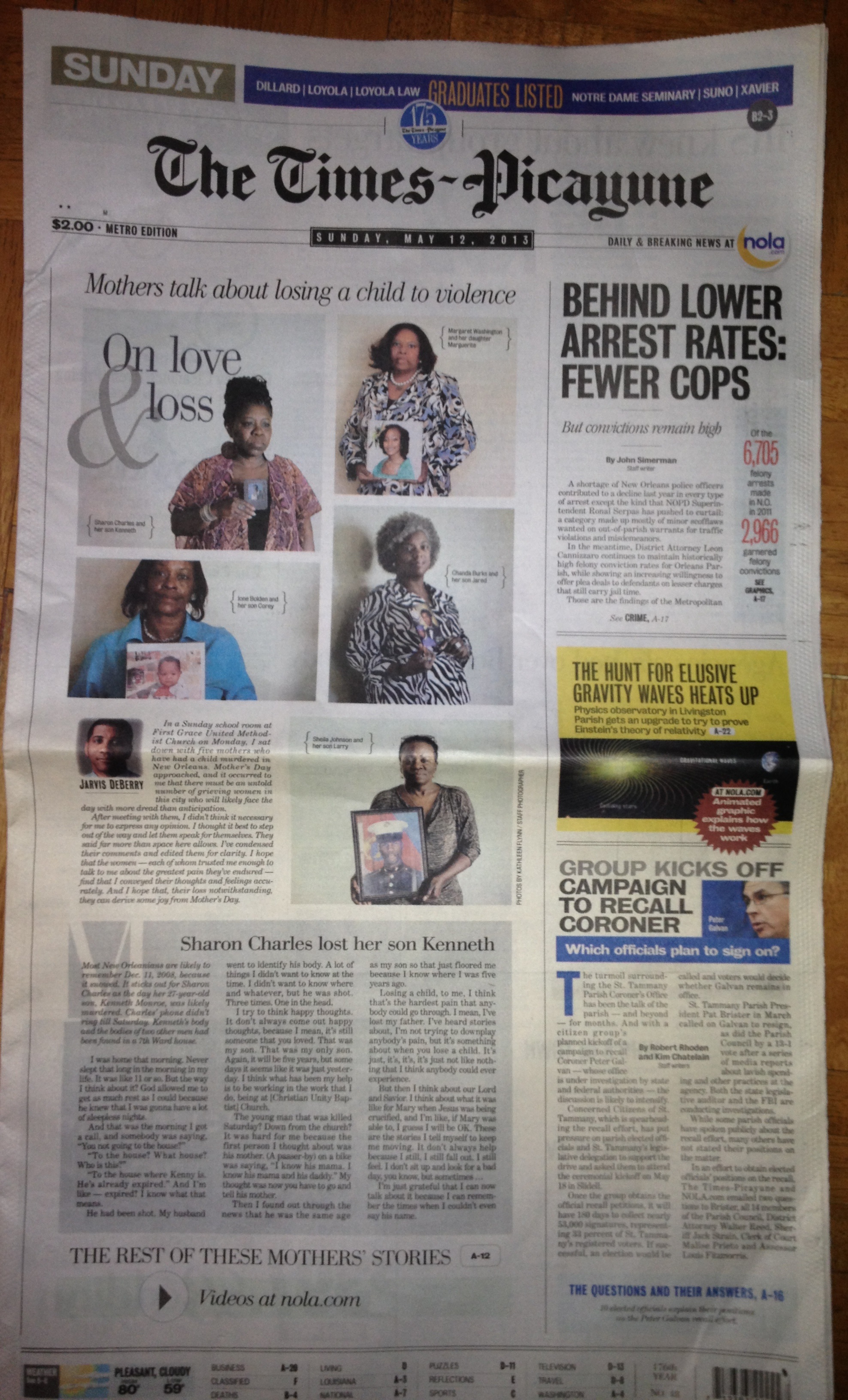
Front page of the New Orleans Times Picayune, Mother's Day 2013,
featuring mothers who've lost children
to gun violence.
On Mother's Day morning, I found the Sunday edition of the New Orleans Times Picayune on my lawn. The picture here shows that day's front page. The headline of the feature story on the left reads, "Mothers talk about losing a child to violence." For many readers this is already yesterday's news, overshadowed later that Mother's Day by another mass shooting injuring 20 people, but as a resident of New Orleans, I can't simply shelve it away and move on.
The woman in the upper right corner of the graphic holding a picture of her daughter is Margaret Washington. Margaret is one of my church members and an hour before I saw the front page, I had hugged her tightly after our Mother's Day church service. She is one of the few non-relatives I come in contact with who knew my mother who passed away in 2008. My mother was almost old enough to have been Margaret's mother, but they knew each other as Dillard University alumni and as members of Delta Sigma Theta sorority.
I knew Mother's Day had to be difficult for Margaret. On October 1, her daughter Marguerite, a student at Dillard, was shot to death while visiting her boyfriend in New Orleans East. I still remember getting the phone call from my aunt, telling me what happened. Someone out to murder the boyfriend, Justin Alexander, shot through his window, wounding him and killing Marguerite. Read the full post at BlogHer.com.
The man in the photo aims at the scattering crowd attending the New Orleans Mother's Day Second Line Parade. Police are currently searching for the suspect, allegedly Akein Scott. But did you notice that small child?
Yesterday, I didn't write much about the mass shooting in New Orleans on Mother's Day. Despite my having started the Urban Mother's Book of Prayers years ago, I had little to say in public. I was somewhere between numb and raving mad, I wrote to someone in email.
We've had so many shootings here, far too many during which a gunman decides to shoot into a crowd or have a shootout on a busy street. We had at least three incidents of innocent bystanders wounded or killed by stray bullets during shootouts last year.
Multiple reports and documentaries have focused on the toll gun violence is taking on New Orleans, especially on our children. Yesterday, I posted the trailer for Shellshocked, one such film.
Yesterday afternoon, I saw a video at NOLA.com of children being interviewed at school about the shooting. All who spoke were terrified, unable to sleep well.
And this morning NOLA.com reports that one of the 10-year-old victims grazed by a bullet at the Mother's Day Shooting is the cousin of little Briana Allen. Ka'Nard Allen was the birthday boy that fateful day when Briana was killed. He was grazed that day, too, at his birthday party. So, with the Mother's Day shooting, he's a victim of gunfire again. He doesn't want to talk about any of this, says the article. You can see how this violence is too much for us all, especially children. See the video below. In it one child questions why anyone has a gun.
In the video above, a cute little girl follows the dance moves of one of NOLA's Calypso Tumblers who perform across the street from Jackson Square in the French Quarter.
Read the latest on this case at this blog at this link.
UPDATES, March 2013: Evidence is mounting against the boys, Elkins and the now-identified 15-year-old Dominique Lang. While Sherry West's story seems off (perhaps due to her alleged mental illnesses), it's starting to look as though she's telling the truth. A gun's been recovered. Read more here.
Today, someone left a link in comments on my post "Baby Shot in Stroller, 2013: Echoes of Susan Smith, 1994" that directs readers to a new element in the Baby Antonio murder case. The story at the link raises more questions about the baby's mother, Sherry West. In the video below, West's daughter, Ashley Glassey, tells a Brunswick, Georgia, television reporter that "she does not want to falsely accuse anyone but she wants the truth."
According to this KSDK story, West lost custody of Glassey when the young woman was eight years old, but Glassey says she has forgiven her mother for whatever took place back then. Nonetheless, she also says that her mother, West, suffers from bipolar disorder with "schizophrenic tendencies." Glassey says that she has been suspicious about the circumstances of Baby Antonio's death since her mother first called her and told her that the 13-month-old had been killed. At that time, Glassey says West changed details about the shooting, saying that the baby was shot first not West as West has since told the media, and shortly after speaking of the murder, West asked how soon did Glassey think the insurance company would pay benefits.
Having dealt with two deaths in my family last year, I consider that it's possible that West wondered about the baby's life insurance benefits because she needed that money to pay funeral expenses. However, as I noted in my second post about the Baby Antonio case, West had his body cremated shortly after his death; therefore, funeral expenses should not have been significant.
Furthermore, in West early interviews, she seemed to me to be very focused on moving back to New Jersey, which made me think that she may have been thinking about moving away from Baby Antonio's father, Luis Santiago, before the baby was killed. As I noted yesterday, an AJC article indicates that Santiago seemed more angry at West when he was notified of the baby's death than he appeared to be angry at the boys she accused: he blamed West for the baby's death.
I also wrote in that post yesterday that West's son Shaun Glassey, who was stabbed to death in New Jersey in 2008, was not the innocent victim of a crime as West represents him in the media. Another boy stabbed her son in self-defense when Shaun Glassey and other teens jumped the boy.
If West has a mental disorder and was the victim of a crime in which she witnessed the shooting of her baby, then this story is even sadder for her. A person can only take so much. But it's equally possible that this story is another kind of tragedy. It's possible that West saw De'Marquise Elkins someplace else, harmed her own baby, couldn't deal with what she'd done, and then hallucinated or invented the story she's told police and the press. I hope the Brunswick police know what they're doing because they quickly arrested the accused boys based on West's story and identification.
Just as West's daughter does not want to accuse her of anything, I also am reluctant to point a finger at her because no one wants to bring more heartache to a grieving mother. West is innocent until proven otherwise. But so are those boys.
I hope people will be careful not to demonize the two teen boys who've been arrested based on the accusations of an unstable woman. And I especially hope that people will not be sucked into the propaganda readily constructed by racists commenting on this crime and who seek to capitalize on this tragedy for the sake of their political agenda.
It's horrible, for instance, that George Zimmerman's brother, Robert Zimmerman Jr, took to Twitter recently calling black teens "killers." He readily assumed that the boys are guilty, did not question Sherry West's strange story at all, and then he equated Trayvon Martin with alleged shooter De'Marquise Elkins. (But Trayvon Martin did not have the gun; George Zimmerman did.) Obviously, the man has an agenda for which he will gladly sacrifice every black teen to achieve. This is just more of the blood lust we Americans must work to avoid.
In the Baby Antonio case, more than ever, we need to be careful to not rush to judgement. It's possible the boys committed this horrible crime, but it's also quite possible that West invented her story accusing them. Either way, a baby is dead, and with no other witnesses and an awareness that West may not be as credible as people have assumed, her version of how her son died needs to be examined.
Updated 3/26/13, 11:00 PM: Police have recovered a gun in the case and Elkins alibi has been derailed. His mother and aunt have been arrested for lying to the police.
I am a fan of both Justified on FX and its star Timothy Olyphant. Here is his interview with Ellen. I really enjoyed it. He's not just sexy; he's also a family man and funny, too.
Yes, I, too, heard about J.C. Penney's sale of the disturbing T-shirt for little girls with the slogan, "I'm too pretty to do homework, so my brother has to do it for me." At BlogHer.com, Shannon L.C. Cate wrote about the controversy expressing the same concern that women and some men all over the Internet voiced as soon as news of the T-shirt broke.
The department store has since pulled the T-shirt from the shelves, but I decided to post Anderson Cooper's commentary on the matter anyway since in it he shows other sexist T-shirts marketed to youngsters that give stifling messages about gender roles. The CNN anchor added J. C. Penney to his RidicuList last night.
I've been so busy that I haven't had time to keep up with what's been happening around me and afar, except for the marsh fire in New Orleans, but I did hear all the Twitterverse and blogosphere buzz over Beyonce's baby bump at the VMA awards Sunday night. When I got a moment to breathe, I tracked down video of her performing "Love On Top."
Yes, in the video, the bump is obvious even under the shiny jacket, but her performance is so strong that I was not focused on the little bulge. However, I can see why her many fans probably watched every inch of her move given that the pregnancy was announced pre-show. She opened her performance with a reference to the baby, saying that love had been born inside her, and then, striding through the glare of bright lights obscuring her image at times, she launched into the song.
I won't spoil your watching the video by saying much more, but I will add that what happened at the end of the song with the other celebrities jumping around on the sidelines, including her husband Jay-Z, Kanye West, and Lady Gaga, was the highlight of the segment. According to the Washington Post, the announcement was the most memorable part of the evening.
In the clip, Broward County, Florida, Judge John Hurley gets "a little choked up" when reviewing the case of a poor woman arrested for leaving her children in a hot car. MSNBC posted:
Angel Smith, 41, (left her two children) in a hot car for two hours while she gave blood to earn money to feed them, the Sun-Sentinel reported.
She was paid around $30 for giving blood, but when she left the center, cops were waiting.
A security guard at the blood donation clinic saw the children - ages 4 and 7 - alone in the car and called police, who arrested Smith on child neglect charges. The children were unharmed and are in the custody of the Department of Children and Families.
In the video, the judge tells Smith, "I don't look at you as a criminal, all right, but at the same token, ma'am, you can't leave your children in the car, that length of time, unattended." She's still facing charges.
This story of the Florida woman touched me because the judge empathized with the woman, who is clearly going through a hard time, and it's good to know that we have judges who don't automatically throw the book at people without considering circumstance. Do you know how desperate you have to be to sell your blood?
At the same time, we've had at least one child die in the New Orleans metro-area in the last three weeks who was left in a hot car and another who nearly died but was rescued by New Orleans Recreation Department workers. A babysitter has been charged with negligent homicide in the death of the first child. She was a family friend who was supposed to take the child to daycare but for some reason she stopped at her house instead and left the child in the car for eight hours. In the second case, the mother, Sha'ron Hudson, 22, has been charged with second-degree cruelty.
In addition, last week a woman was arrested in Westwego, La., after leaving two children, ages three and six, in the car with the air conditioner on low. She was shopping in the grocery store. A passerby saw the children who were sleeping and called the police. While that woman used poor judgment, at least she was aware that she should not leave children in a hot car.
The local paper reports that the children's father said the woman who was arrested is not the children's biological mother and he defender her. Apparently she's his wife. Police told WDSU that she was the third woman arrested for under such circumstances this summer. I don't know if they were referring to the two cases I mentioned earlier or other cases.
The police handling the case sounded frustrated and angry. It is indeed hard to fathom why people do this, especially during the summer down here when local stations run announcements and segments telling of the dangers of leaving children in cars with temperatures outside above 90 degrees. It's difficult to understand sometimes why people leave children in cars alone at all given the news stories carjackings where the thieves didn't realize a child was in the car, not to mention all the warnings about child predators.
Imagine how distraught the Westwego woman would have been if someone had abducted her husband's children or how terrified she would have been if the children had awakened and done what one of my younger cousins did when he was a slightly more than two years old. He tried to drive his parents' car and rolled into a busy street. The keys weren't in the car, but the door was unlocked. My uncle, his father, was working in the yard when my cousin climbed in the car and messed around enough to release the brakes. The car rolled back into the driveway and reached the part that sloped downward. Gravity took over and the car rolled into the street. Fortunately, no cars hit him.
The white mother in this video is funny. Her complaint is that black people have been inadvertently hiding their skin care secrets from whites, and she wants that to stop. Furthermore, she wonders how many other secrets black people are keeping from whites that could help them. The video description reads in all caps:
BLACK PEOPLE TELL US YOUR OTHER SECRETS! LIKE HOW THE HELL ARE YOU 95 YRSOLD AND LOOK 35?????
WHITE PEOPLE GO GET YOU SOME BUTTERS STAT...GET OFF THE LOTION..
New Jersey talk show host Lisa Durden shared this video silliness on Facebook which comes from Heady1313 on YouTube, and I'm glad because I take my laughs where I can get them. However, on a political note, white people through colonization and in the guise of academic or scientific research have studied black people for a long time and walked away with our cultural knowledge, frequently earning dollars off our culture that are never returned to us. I guess I'm laughing in part here at the irony of which Heady1313 may be unaware or cleverly plucking at the domesticity level.
Some people thought she was dead serious in "the butters," but I didn't. Nor did I find the video offensive.
What I've gathered is that Heady1313, who is also on Twitter, has Multiple Sclerosis that's left her in a wheelchair and she committed to vlogging for a year. Her first video talks about feeling like she's an inconvenience, but before that she says that she hopes through blogging, "to make MS my bitch."
After being shown on Fox News, uploaded as cellphone video to YouTube, and then reported on WWL TV, New Orleans, this story's gone viral:
Outrage after TSA pats down 6-year-old at N.O. Airport NEW ORLEANS -- Some civil rights advocates are outraged after a 6-year-old girl received an intense pat-down at Armstrong International Airport security on April 5. ... Someone caught the pat-down on video, and it's making its way around the Internet. ... It has many asking, are the intense security screenings really necessary, especially for a little girl? ... “A child who is visibly, audibly complaining, ‘I don't want to do this,’ should at the very least be given some privacy,” said Marjorie Esman, executive director of the ACLU Louisiana.
This happened in my hometown, but I've been so busy I heard about it on Facebook from Lisa Durden, a New Jersey talk-show host. She said the following:
Hmmm, I conflicted, while I am disturbed that a little girl got a body pat down at the airport, but unfortunately, people have & do stash Contraband & bombs on children. So I was glad to see that it was a female TSA agent who explained to the girl where she was gonna touch her. These are the times we live in so the parents should have prepped her before hand.
Some people interviewed in the news footage had similar opinions. Since the TSA can choose to scan some passengers and physically pat down others, the complaint from parents is that perhaps TSA should be more selective and only scan children, not physically touch them.
In the video at YouTube, you can hear a child complaining, but it's not the little girl who is being searched.
I just read about the exceptional foolishness of a misguided southern publisher. At CNN, a Mark Twain biographer, Ron Powers, calls NewSouth Books' decision to strip the word "nigger" from Mark Twain's classic Huckleberry Finn, "vapid, smiley-faced effrontery ... (that) corrodes the foundations of respect for American literature." I agree with Mr. Powers and also commentary at the Washington Post, and I report sadly that I always knew the misunderstandings about political correctness would come to this.
While PC speech has some benefits, it was inevitable that mishandling its purpose would eventually spawn idiots who butcher the works of brilliant creative writers. I say mishandling because I don't think this attack on Huck Finn is political correctness as much as I think it's another example of the South's attempt to rewrite itself.
So, to my fellow African-American Boyce Watkins, who thinks it's good to cut the word from Huck Finn's adventures, I say, "You, sir, are wrong!" Parents, even black parents, would do better to teach their children about the history and times of Mark Twain's book than to coddle them by creating the illusion that no one has ever used the word "nigger." The book teaches us something about people and America even as it supplies bittersweet moments (See PPR_Scribe's "My Nigger Story.").
Yes, I have indulged the pleas of a cute child who asked us to "ban the 'N' word," but that's as far as I go; I'll weep for a moment with a little boy while I recall the first time the "N" word was used against me and then I will stand strong. Oh, if I'd had a gun back then, I would have struggled not to pull the trigger, but it was a person who used the word and had he not known that word, then he would have used another insult. His intent was to do harm.
BTW, some folks are already trying to ban the word "Negro." How far will this go? That other "N" word story surfaced this time last year. Maybe we're now on an annual "N" word controversy schedule.
People who can't abide the word "nigger" under any circumstances regardless of context, usage or intent, who would censure literature perhaps in lieu of politicians and poor role models in everyday life or who think humans are too stupid on their own to learn how and how not to use words, are themselves boneheaded. And I say this after considering how the "N" word is used and has been used and after speaking out against racism often. And no, I do not believe that in order to stop white people from using the word as an insult, black people must not use it as well. Folks who want to hurt or misguide you with words have alternatives. (See Russell Peters Mondays jokes). Plus, black people should have the right to code switch the same way other people do, and white people should be bright enough to know that they are not us.
I wouldn't dare call a white single mother from a mobile home in Slidell, La., a slip of poor white trailer trash no matter how often I heard others define her that way or how many times she might call herself the same. If I know not to do that, then white people should know not to use the "N" word.
Furthermore, I do think when people misuse the word in the name of their own insecurities or as a racial slur against people of color (See John Mayer, some black rappers, and some whites and soldiers who indulge calling Arabs "sand niggers"), they should be confronted. I expect them to know better and think they are smart enough to know they should not speak to people or of people in a certain way. I expect them to know this the same way a man knows if he wants the female bank loan officer to look favorably at his loan application, he can't roll up to her desk saying "bitch." What we all know is that if you don't use a word when you need a favor, then you probably shouldn't use it when you don't.
When it's convenient to them, white people—make that all people—know when they're leveraging racist language to impress, intimidate, or divide as can be seen in this clip of white conservatives taking another conservative to task about his racial word shenanigans. And we also know the difference between the technical definition of racism--the belief that one race is superior to another--how that belief is preserved in our institutions and the blatant racism practiced and promoted by groups like the KKK. We know the difference between the facile ignorance of people who deny they benefit from white privilege and the undiluted hatred of card-carrying, cross-burning racists. We know it all creates chaos and inflicts pain in myriad ways that surpass use of the "N" word.
Nevertheless, far more times than not there is rarely an excuse for speaking this word in mixed or even segregated professional company. And yet, there may be compelling reasons to use the "N" word in fiction or poetry and sometimes even music.
I have a huge problem with a publisher changing Mark Twain's words in the same way I would have a problem with a publisher changing the words of Zora Neale Hurston. In Jonah's Gourd Vine, a story based on her parent's courtship and marriage and that reflects accurately lifestyles of African-Americans in the late 1800s and early 1900s in Notasulga, Ala., and Eatonville, Fla., she has lines such as "... Booker T. Washington. Nigger so smart he et (ate) at de White House. Built uh great big ole school wuth uh thousand dollars, maybe mo.'"
Not only a writer but also a trained anthropologist and ethnographer, Hurston knew how to write and speak in Standard English but indulged writing in dialect, a fad during her time when writers were sometimes obsessed with reflecting regional speaking styles accurately in dialogue. A folklorist, she also believed in showing how people speak in ways that reveal heritage, culture, and social circumstance. Hurston was a product of her time as was Twain. Consequently, their writings reflect their worlds, and if we assault their works, sanitizing them for our own vanilla sensibilities, we will lose not only the flavor of the nation's old literature but also find we have tampered with perceptions of history.
As a writer, I have other feelings about using the word as addressed in my post "Speaking Out on the 'N' word." In that post I have some examples of artists/poets using the word.
Writers use a character's language to give readers insight into a character's nature, to make characters three-dimensional. For instance, if my character were a racist, would it seem odd that he never used the word "nigger"? If the character is from an environment, even a black character, that uses the word frequently, would my character seem less authentic if he and the other characters around him never used the word?
Should the writer edit dialogue to censor his character's speech, and does such editing detract from the story? Does the story suffer or benefit if the word is eliminated? I ask myself these same questions when I create characters who would naturally curse and curse often.
And so, I would not even agree with stripping the word "nigger" from a piece of fiction written today.
In addition, I think this move of a white publisher in Alabama of all places wanting to strip the word "nigger" from Huckleberry Finn seems like too disingenuous an act to be approved on face value. It reminds me of those Texans rewriting history and social studies textbooks, or Mississippi's Gov. Haley Barbour's attempt to redefine the racist Citizens Councils of his youth, and Virginia textbooks teaching that thousands of black people fought for the Confederacy because a writer was so desperate to fulfill that state's requirement to teach about the rebels in a more favorable light that she goofed. It's all an attempt to scrub history and lift up the South again to smell like roses. The motive is to distort reality and make us forget the evil things done.
Why must we go to extremes? Why can't adult humans of all races embrace the knowledge that lets them understand context and intent? Sometimes we behave as though we are incapable of comprehending language enough to know when we've heard an insult or of manipulating language in ways that either enlighten or deceive. Instead we pursue banning words to the point of censoring creativity.
And what's next, to strip from Shakespeare insults to short people or to rewrite his Merchant of Venice and forget it ever contained elements of antisemitism? Shall we edit Jonathan Swift's Gulliver's Travels so no words in the text disdain women, obscuring the battle of the sexes, concerns about women controlling consumerism, and the fears that males would lose the power of science during his time?
I think we should speak civilly to each other. However, I also think that if our teachers aren't skilled enough to teach Huckleberry Finn as is and explain historical context and cultural influences on a period's race relations, if teachers can't illuminate the significance and meanings of difficult texts and American students are too daft to grasp shades and styles of writing, then why do we have schools at all?
Nintendo is warning buyers of its new 3DS that exposure to 3D gaming could stunt eye development in children under six years old. I saw this story at CNN, where the writer says it's possible to switch off the 3D functionality.
Nintendo further warns:
"... everyone who plays the 3-D gaming system to take periodic breaks from the games as often as every hour or 30 minutes."
Right now on CNN, Joel Burns, an openly-gay council member in Fort Worth, TX, is being interviewed. His emotional appeal made Tuesday night, October 12, at a city council meeting has gone viral. It's posted below the CNN video here in its entirety and was aired earlier today on the network. Burns gave the speech in response to the rash of suicides resulting from bullying in general and homophobia-driven bullying in particular.
At BlogHer last month, a staff member posted another "It gets better" video from two gay men who also addressed teens who are being bullied. View that one here. It's part of an organized project by the same name.